Ideally I'd like to make bread with flour that's 100% organic stoneground wholemeal and British. There are a number of small mills producing flour that fits the bill but when I tried Gilchester Organics I didn't have much success. I've become more experienced since then and I have now tried a more local flour - Sunflours from near Ripon in North Yorkshire. I've tried the organic stoneground wholemeal - this isn't described as strong but on the packet it does says it is suitable for bread making. It gives the protein as 12g which is the same as Gilchester but lower than other strong wholemeal flours. To give it a good chance I made a loaf with 50% white flour.
350g Sunflours organic stoneground wholemeal flour
350g Marriages organic strong white flour
3g dried yeast
10g salt
11g butter
11g brown sugar
440g water (at about 30C)
I mixed the ingredients, kneaded for 10 minutes and put the dough in a 10 litre plastic box with lid. I left this at room temperature until the following evening (about 20 hours). I then tipped it out onto a floured worktop, pressed it down into a rectangle and rolled it up tightly to go in my large 2lb loaf tin. Covered with oiled cling film it went into the oven at 30C for 2 hours to prove. It crested the top of the tin so I took it out of the oven which I then set to its highest setting of 300C top and bottom heat (without fan). Once it was up to temperature (I check this with an oven thermometer now as I don't think the oven is fully hot when it says it is) I sprayed the top of the loaf with water and sprinkled with rye flour. Into the oven and the temperature down to 240C. It was in for a total of 30 minutes with the last 5 or 10 out of the tin.
This gave a nice amount of oven spring which I wasn't expecting - it seems this only happens when I'm not trying. I think the really hot oven helps this - trying to introduce steam seems to be a waste of time.
After the loaf had cooled I tried a slice - I was very impressed. Lovely flavour and nice texture. The only other flour that has tasted this good is the Marriages organic wholemeal although I need to do a comparison with the Waitrose organic using the exact same recipe. Despite the high white content the taste was superb.
So, a British flour that has worked well for me. The real test will be if I replace the Marriages white with the Sunflour white and if I increase the percentage of wholemeal. I shall also try the Gilchester again as I think the overnight bulk fermentation helps develop the gluten. In fact, I suspect there is no need to knead so much. As always there are lots of things to try.
Thursday, 7 April 2011


Thursday, 17 March 2011
More experimentation
Firstly, I'm pleased to say that the loaf I baked in the previous post didn't have any flying crust. The crust did shrink a little but it was still attached to the crumb and nice and soft, just not very even.
Over the last couple of weeks since my last post I have continued to bake bread trying out different ideas. I have managed some success and one failure. Three ideas I have been trying are to use potato water (that's just water used to boil potatoes), proving with less yeast at room temperature instead of the fridge and kneading in a different way. This is the use of three very short kneads over half an hour instead of a continuous 10 minute knead. It's the technique championed by Dan Lepard and used in his sour cream sandwich loaf (see my earlier post):
The great success was 100% white bread. For the liquid I mixed a small amount of fat-free Greek yogurt (just what was left in the pot) and potato water and then made it up to the full amount with full-fat milk. I made two large loaves with 1200g flour and 720g liquid - about 500g of this was the potato water. I used about 4g of dry yeast and kneaded as described above. I left it overnight. Over this period I had to knock the dough down in the bowl a couple of times - the milk probably provided enough sugar for the yeast. I divided the dough in two and shaped each piece just by flattening it and then tightly rolling. I cooked the loaves for about 30 minutes at 200C. One loaf had risen by more than the other and it also sprang up in the oven quite well. So high temperatures and steam don't seem to be necessary for oven spring.
Last night's bread was for two large loaves as follows:
Over the last couple of weeks since my last post I have continued to bake bread trying out different ideas. I have managed some success and one failure. Three ideas I have been trying are to use potato water (that's just water used to boil potatoes), proving with less yeast at room temperature instead of the fridge and kneading in a different way. This is the use of three very short kneads over half an hour instead of a continuous 10 minute knead. It's the technique championed by Dan Lepard and used in his sour cream sandwich loaf (see my earlier post):
- After mixing the dough in the bowl, cover and leave for 10 minutes.
- Turn the dough out on to an oiled work surface and knead for 10 seconds. I think in practice I do it for longer.
- Cover and leave for 10 minutes.
- Knead for another 10s, cover and leave for 10 minutes.
- Do one more knead. So that's three kneads over 30 minutes.
- Clean out the bowl and put the dough back in and cover. (I use oiled clingfilm but you can also use a plastic bag or a floured cloth).
- Leave for at least an hour. I usually leave overnight or till the next evening (about 20 hours).
The failure was a 100% wholemeal brick. I used potato water and half the flour to make a sponge which was left for about 24 hours. I then added the flour and salt and left it for another 20 hours before shaping for the tin. It didn't rise in the tin and didn't spring in the oven. Although a nice taste it is just too heavy and so it will be blitzed in the food processor and given to the birds. I didn't add any sugar and I suspect the yeast ran out of food over the very long proving time. I thought the potato water would provide food but that's starch and not sugar.
The great success was 100% white bread. For the liquid I mixed a small amount of fat-free Greek yogurt (just what was left in the pot) and potato water and then made it up to the full amount with full-fat milk. I made two large loaves with 1200g flour and 720g liquid - about 500g of this was the potato water. I used about 4g of dry yeast and kneaded as described above. I left it overnight. Over this period I had to knock the dough down in the bowl a couple of times - the milk probably provided enough sugar for the yeast. I divided the dough in two and shaped each piece just by flattening it and then tightly rolling. I cooked the loaves for about 30 minutes at 200C. One loaf had risen by more than the other and it also sprang up in the oven quite well. So high temperatures and steam don't seem to be necessary for oven spring.
Last night's bread was for two large loaves as follows:
- 900g wholemeal bread flour
- 500g white bread flour
- 930g liquid (about half and half potato water and tap water)
- 15g salt
- 20g light brown sugar
- 4g yeast
Three quick kneads and in the bowl at room temperature until the next evening. The dough rose very well and had to be knocked down several times. Divided into two tins and left to prove. Baked at 200C for 35 minutes with the last 5 out of the tin. Reasonably successful but I would change a few things:
- Less liquid. The dough was a bit slack and so when it rose in the tin it spilled down the side instead of going up. This is a similar amount of liquid I have used before so perhaps the potato water affects this.
- More salt. I decreased the salt but probably by too much as it tastes a bit bland. Probably should have used 20g.
- Less yeast. Having to knock the dough down in the bowl several times shows there was plenty. Another option would be to put the dough in the fridge overnight but then leave it at room temperature during the day before baking in the evening.
- Knead the traditional way. I want to see if this makes a difference but I would need to compare two identical recipes for this to be valid.
- Bake at a higher temperature. The loaves are a bit pale and the crust is a bit thick. This may change after a day or two but I think going back to a higher temperature and cooking for less time would help this. At high temperatures I find the loaf looks burnt but isn't.
Tuesday, 1 March 2011
Variations
I have repeated my previous recipe a couple of times but with some variations. The first was to bake it at 200C for 40 minutes with the last 10 of those out of the tin. This was very similar to the previous except the crust was not as brown.
The other was to omit the sour cream and to increase the water to 465g. This rose a bit more in the fridge overnight and then again during the day. However, the rise in the tin, while OK, was not nearly as spectacular as with the sour cream. It seems as if the sour cream is not doing so much in the fridge and then putting in lots of effort in the tin. This was also baked at 200C. You can't tell from the photo but I am concerned that this may have a flying crust.

The other was to omit the sour cream and to increase the water to 465g. This rose a bit more in the fridge overnight and then again during the day. However, the rise in the tin, while OK, was not nearly as spectacular as with the sour cream. It seems as if the sour cream is not doing so much in the fridge and then putting in lots of effort in the tin. This was also baked at 200C. You can't tell from the photo but I am concerned that this may have a flying crust.

Monday, 21 February 2011
More sour cream
I added sour cream to one of my normal recipes:
400g wholemeal strong flour
300g white strong flour
125g sour cream
340g (approx) warm water
10g light brown sugar
7g dry yeast
10g salt
I mixed the sour cream, water, sugar, yeast and salt together first and then added the flour. I adjusted the exact amount of water to get the dough to the right consistency. I kneaded it in the normal way for 10 minutes or so.
The overnight rise was ok but not amazing, although the fridge does seem to be colder at the moment (2C instead of 4C). I knocked it down and put it back. The following evening it didn't seem to have risen much so I was not too hopeful.
I left the bread to rise in the loaf tin for longer than normal - about 2 hours at 30C followed by 1 hour at room temperature. The bread rose spectacularly in this time. I was worried it may have over proved.
In the oven at 260C with steam for 10 minutes there was no oven spring - in fact it shrank a little. The top was quite brown so it was down to 200C for 15 minutes plus 5 more out of the tin.
400g wholemeal strong flour
300g white strong flour
125g sour cream
340g (approx) warm water
10g light brown sugar
7g dry yeast
10g salt
I mixed the sour cream, water, sugar, yeast and salt together first and then added the flour. I adjusted the exact amount of water to get the dough to the right consistency. I kneaded it in the normal way for 10 minutes or so.
The overnight rise was ok but not amazing, although the fridge does seem to be colder at the moment (2C instead of 4C). I knocked it down and put it back. The following evening it didn't seem to have risen much so I was not too hopeful.
I left the bread to rise in the loaf tin for longer than normal - about 2 hours at 30C followed by 1 hour at room temperature. The bread rose spectacularly in this time. I was worried it may have over proved.
In the oven at 260C with steam for 10 minutes there was no oven spring - in fact it shrank a little. The top was quite brown so it was down to 200C for 15 minutes plus 5 more out of the tin.
 |
| The loaf is a day old and the crust has shrunk a little. It is now much softer than when baked - it is not burnt |
 |
| No flying crust, despite my fears |
 |
| A lovely crumb - very soft |
Tuesday, 15 February 2011
Sour cream sandwich bread
I made Dan Lepard's Sour cream sandwich bread and it rose nicely with some oven spring although still not a huge amount. Even though the recipe uses 550g flour compared to my normal 700g it ended up taller than my loaf recipe although using 100% white flour must help. The sour cream may be the secret ingredient though and I will have to try adding it to my bread to see if it helps.


Too much salt and yeast
I managed to scale some of the ingredients for the bread incorrectly. I previously made two loaves with 500g of flour each. For my new, larger tin, I need 700g of flour. I should have scaled the recipe from 1000g down to 700g but instead I scaled up from 500g to 700g so, although I got the water right, I managed to use twice the amount of salt and yeast.
The recipe should be:
400g wholemeal strong flour
300g white strong flour
465g water
10g salt
7g yeast
I made the loaf again with the right ingredients and again it was good.
The recipe should be:
400g wholemeal strong flour
300g white strong flour
465g water
10g salt
7g yeast
I made the loaf again with the right ingredients and again it was good.
 |
| The dough stretched out to about three times the length of the tin. |
 |
| The dough folded for the tin. |
 |
| The dough patted down before rolling. |
 |
| The dough in the tin before proving. |
 |
| The dough nicely risen before going in the oven. |
 |
| The baked loaf just out of the oven. |
 |
| You can see where the loaf has sprung in the oven just above the tin line. |
 |
| Nice crumb. |
Tuesday, 8 February 2011
Success
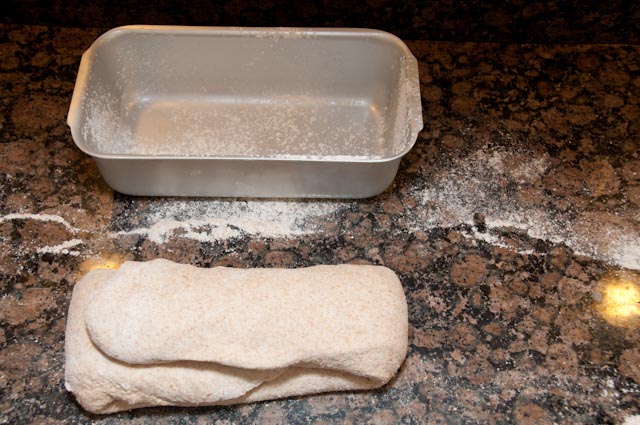
Overnight the dough rose a decent amount so I knocked it back and put it back in the fridge. This evening it had risen again so I shaped it and put it in the greased and floured loaf tin. I followed the shaping process at breadsecrets.com where the dough is stretched out to three times the length of the tin, folded back twice and then rolled up.
After an hour and a half the dough had risen to the top of the tin. I preheated the oven to 275C with the grill pan. Once the oven was nice and hot I poured boiling water into the grill pan and then waited a minute. Sprayed the bread with water and then into the oven. After 10 minutes, grill pan out and temperature down to 220C. After 15 minutes I took the loaf out of the tin and put it back in for a final 10 minutes.

There was some oven spring but not a huge amount but it least the loaf hadn't shrunk like before.

So what was different this time:
After an hour and a half the dough had risen to the top of the tin. I preheated the oven to 275C with the grill pan. Once the oven was nice and hot I poured boiling water into the grill pan and then waited a minute. Sprayed the bread with water and then into the oven. After 10 minutes, grill pan out and temperature down to 220C. After 15 minutes I took the loaf out of the tin and put it back in for a final 10 minutes.

There was some oven spring but not a huge amount but it least the loaf hadn't shrunk like before.

So what was different this time:
- Making enough dough for the size of tin so it didn't overprove.
- Getting the right hydration. Instead of just putting in a fixed amount of water I put in enough to make the dough feel right - not too dry and not too wet and sticky.
- Simple recipe - I suspect the oil may have not done the gluten any good. Certainly the dough felt much better this time.
- Shaped the dough differently.
- I put boiling water into the grill pan a minute before the loaf went in.
Subscribe to:
Posts (Atom)